
Building Resilience Through Communication in Wartime Ukraine
The war in Ukraine has made it clear that communication and access to information are essential societal functions. The experience of the Ukrainian civil society organization Dovidka.info shows that effective crisis communication is rarely about more messages or more channels. It is about trust, cooperation, and the ability to reach people where they are.
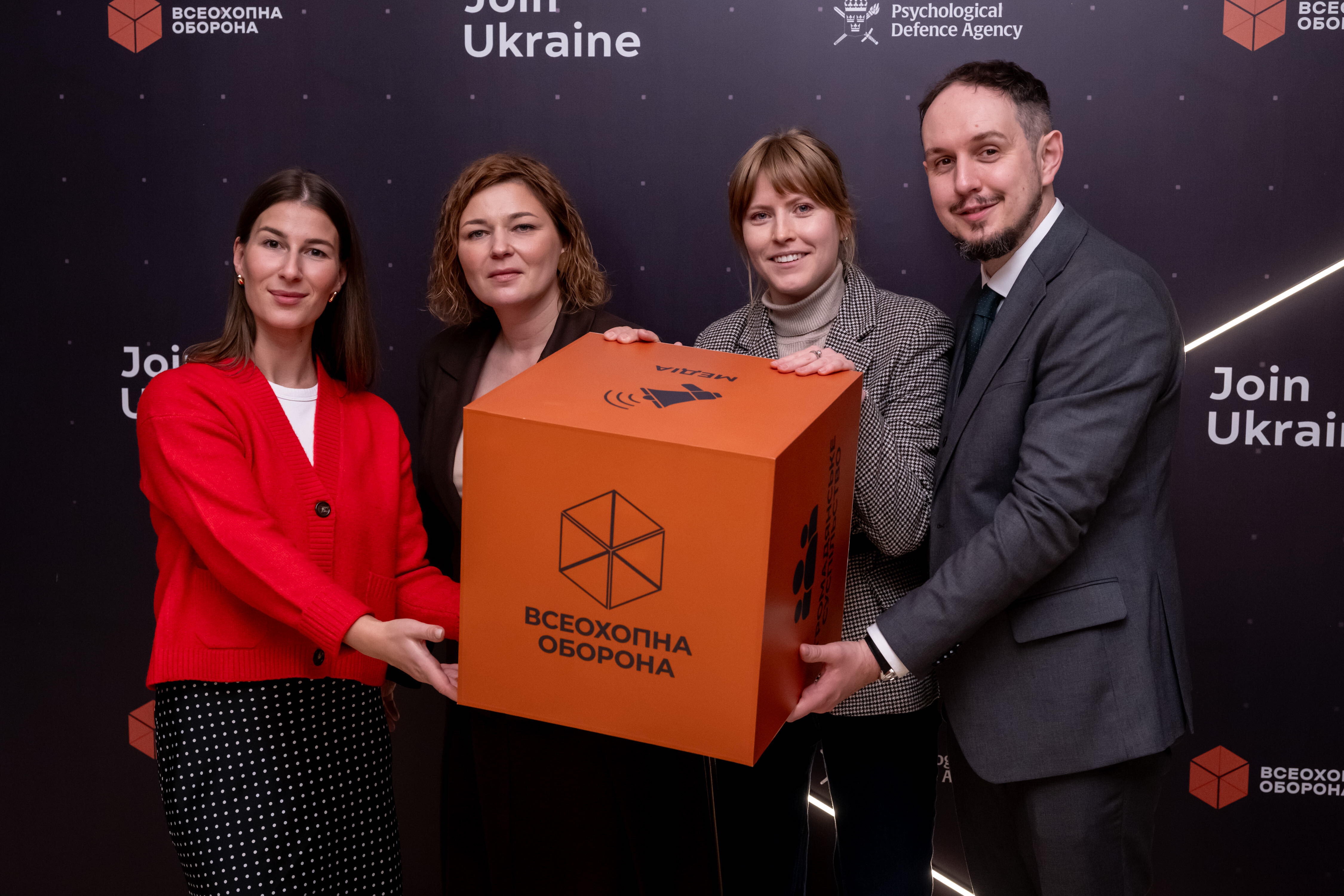
The Dovidka.info staff, from the left: Yuliia Osmak, Alisa Malytska, Khrystyna Kataryna och Yarema Dukh.
Since 2025, the Swedish Civil Defence and Resilience Agency has contributed financial support to enable Dovidka.info's efforts to develop and disseminate public information campaigns on crisis preparedness and wartime resilience for citizens across Ukraine.
“We see our cooperation with Dovidka.info as a partnership. By strengthening their crisis communication capabilities, we are also strengthening Ukraine’s resilience. Our support is now entering its second year, and we are pleased that it will continue throughout 2027,” says Johanna Rixer, Project Manager at the Swedish Civil Defence and Resilience Agency.
One of the most important lessons learned is not to start from scratch when a crisis occurs. Rather than creating new communication channels, Dovidka has often supported existing actors such as local newspapers, radio stations, and other established sources of information.
“People turn to sources they already know and trust. In a crisis, there’s no time to build an audience from scratch, so invest in the local media, institutions and community voices that already have people’s.” says Alisa Malytska, co-founder of Dovidka.info.
The same principle also applies to cooperation between government institutions and civil society organizations. If someone is already producing effective content or doing valuable work, it is often better to strengthen that effort than to create a parallel solution.
Start with the Audience
A recurring lesson is that communication must begin with people’s needs, not with the message itself. The work should start with questions such as: Who needs this information? What problem are we trying to solve? Which channel is most effective for reaching the target audience? Only then should the content be developed.
“Information only leads to action if it is clear and practical. People need guidance, not bureaucracy. If trusted media and institutions pick up and share our messages, we have succeeded,” says Yarema Dukh, co-founder of Dovidka.info.
Trust Is Essential
In a crisis, people often listen more closely to individuals they recognize than to government officials. In Ukraine, train drivers, emergency responders, and other highly trusted professions have been used as messengers in public information campaigns.
“Our experience shows that familiar faces increase trust and compliance with important advice. In an emergency, institutions provide support, but trust is often built by frontline workers. It’s like airline safety: the instructions come from the flight attendant, not the CEO,” says Khrystyna Kataryna, Social Media Manager for Dovidka.info.
Crisis communication must also take people’s circumstances into account.
“War fatigue makes people less receptive to preparedness messages. That’s why we use new approaches, creative reminders and sometimes humor to keep people engaged without adding to their anxiety,” says Alisa Malytska.
For this reason, Dovidka emphasizes empathy and realistic expectations rather than guilt-based messaging.
AI Is Amplifying Information Operations
Artificial intelligence does not change the fundamentals of propaganda or disinformation, but it makes influence operations faster, cheaper, and more targeted. AI can be used to generate large volumes of content, tailor messages to specific audiences, and amplify existing divisions within society.
“AI helps us identify deepfakes and coordinated campaigns, while also making it faster to translate, simplify and adapt life-saving information for different audiences,” says Viktoriia Merlych, the Centre for Strategic Communications representative.